
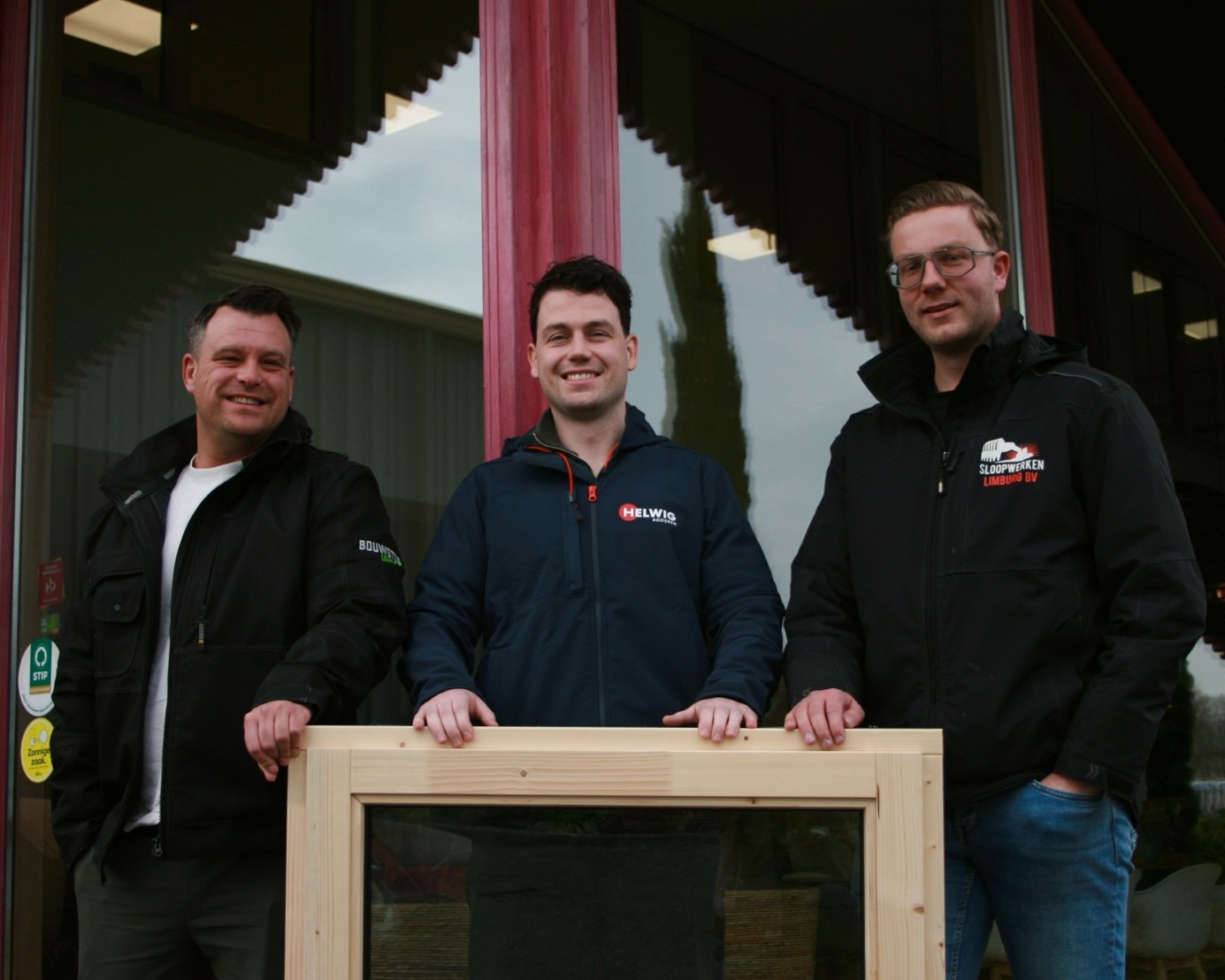
Helwig meets Sloopwerken Limburg
How can demolition wood be reused in circular window frames?
A circular ambition in search of a workable chain
Innovation in construction often starts with a technical question. For Helwig Kozijnen, innovation and sustainability have long been part of the company’s way of working. As a specialist in timber window frames, Helwig continuously invests in improving its products, both in terms of quality and environmental performance. Because wood forms the foundation of their products, it also offers the greatest opportunity to make a real impact on the sustainability of the buildings in which these products are used.
From that perspective, the next step seemed logical: finding a way to integrate reclaimed timber into the production process. Not as a replacement for all new timber, but as a practical first step towards a more circular product. The ambition itself was clear, yet the route towards it proved less straightforward. Reclaimed wood differs fundamentally from new timber. Every beam comes from a different building, has a different history and has been exposed to different conditions. That makes it far less predictable as a raw material and much harder to integrate into an industrial production process.
It was this challenge that brought Helwig into contact with the European Center for Circular Building and Transformation. The question they brought was practical: where can we find a reliable stream of reclaimed timber that is suitable for industrial application? What started as a simple request for support quickly developed into a broader conversation about supply chains, material quality and the practical organisation of reuse.
Finding the right partners
In the conversations that followed, it became clear that the biggest challenge was not the lack of material itself, but the organisation of the chain behind it. Through the ECCBT network, it was already known that Sloopwerken Limburg had access to substantial timber flows from demolition projects across the region. For years, the company had been selectively recovering reusable materials from buildings, including structural timber, yet these wood flows had mainly been used in smaller applications or fragmented sales rather than being integrated into industrial production.
Recognising the potential connection between both parties, ECCBT invited Helwig to one of its Circular Breakfast Sessions, where entrepreneurs and partners from the circular construction ecosystem come together to discuss practical opportunities and challenges. It was during one of these sessions that Helwig and Sloopwerken Limburg first met and immediately recognised the value of working together. Helwig had a clear demand for reclaimed timber, while Sloopwerken Limburg had direct access to the material stream. What had been missing until that moment was the connection between supply and demand.
At the same time, it became evident that making the match between the two companies was only the beginning. Turning demolition timber into a usable industrial material requires technical knowledge, logistical planning and practical insight into how material flows can be organised. This is where Bouwstof Limburg and Tom Beekhof played an important role. Through his work within ECCBT’s Processing & Logistics pillar and his practical expertise in material reuse, Tom helped shape the operational side of the chain, looking at how the material could be collected, prepared, transported and processed in a way that would work for every partner involved.

From demolition site to production line
The chain itself begins at the demolition site, where Sloopwerken Limburg recovers timber from buildings that are being dismantled. Instead of treating the material as waste, the wood is carefully removed and collected as a reusable material stream. Because this happens across multiple demolition projects, a stable and continuous flow of timber starts to emerge, which is essential for any industrial application. A manufacturer like Helwig does not need occasional supply, but consistency.
Before the wood can move further into the chain, it first needs to be prepared. At this stage, Sloopwerken Limburg manually removes screws, nails and other residual materials that remain attached to the timber. Although this is a labour-intensive process, it is necessary to ensure that the material can safely enter the next stage of industrial processing. The company is already exploring ways to improve this step, including the possibility of involving social workshops and workplaces for people with a distance to the labour market. If realised, this would add a social dimension to the circular chain, combining material reuse with social employment opportunities.
Once the wood has been prepared, it moves into the next phase of the chain, where the logistics become particularly efficient. Helwig already works with a processing partner in South Germany that regularly supplies timber materials to the company. Under normal circumstances, the trucks delivering these materials return empty after unloading. Within this new chain, those return journeys are now used to transport the reclaimed timber collected by Sloopwerken Limburg, creating a more efficient use of existing transport capacity. This reduces empty kilometres, lowers transport costs and improves the CO₂ performance of the chain without introducing additional transport movements.
Transforming reclaimed timber into a new product
After arriving at the processing facility in South Germany, the reclaimed timber enters the industrial transformation phase. Here, the wood is sawn, sorted and processed into structural timber components that meet the technical requirements needed for Helwig’s production process. This processing step is essential because raw demolition timber cannot simply be integrated into industrial manufacturing. It first needs to be stabilised and transformed into a predictable and reliable material that can function within an existing production line.
Once processed, the timber returns to Helwig, where it is integrated into the inner structural layers of laminated window frame beams. This is a deliberate choice. The inner layers of the beam are less exposed to weather and external influences, making them the most suitable place to introduce reclaimed timber while maintaining the overall technical performance of the product.
Through this approach, Helwig can replace approximately 50% of the timber in selected product components with reclaimed wood. Although this does not yet make the entire product fully circular, it represents a significant step forward and proves that circular material streams can be integrated into industrial manufacturing without compromising product quality.
Innovation beyond the material itself
What makes this project particularly interesting is that the innovation does not stop at the product level. It also extends into certification and standardisation. At this moment, Helwig is working together with its chain partners to develop a KOMO certification pathway for circular timber applications, as such a certification route does not yet formally exist.
This means that the partners are not only developing a new circular product but are also helping shape the standards needed for similar products in the future. Certification is the final step needed before the product can move from pilot phase to market introduction, making it a crucial part of the development process.
At the same time, this case also highlights broader challenges that are relevant for circular construction. The cross-border movement of reclaimed materials still raises legal questions, particularly around the distinction between waste and product. This legal classification directly affects transport regulations, administrative requirements and liability structures, and will become increasingly important as circular supply chains continue to grow.

The next step towards scaling
With the first test products now within reach, the focus shifts towards scaling the chain. This means finalising the certification process, improving legal clarity around cross border transport and further strengthening the economic model behind the collaboration.
For circular chains like this to become structural, every party involved must benefit from the process. Demolition companies need a workable revenue model for harvesting materials, processing partners need stable volumes to justify their operations, and manufacturers need reliable quality and predictable pricing. Only when those conditions align can circularity move beyond experimentation and become part of the regular market.
This collaboration between Helwig, Sloopwerken Limburg, Bouwstof Limburg and ECCBT shows that circular construction is not simply about replacing one material with another. It is about organising an entire chain differently, connecting the right partners and building a system in which reuse becomes practical, scalable and economically viable.
What started as a question about reclaimed timber has grown into something much bigger: a working example of how circular construction can move from ambition to implementation, not by reinventing the system, but by connecting and improving the one that already exists.