
The construction sector is under increasing pressure to reduce waste, lower carbon emissions, improve circularity, and create healthier living environments. While new technologies often receive most of the attention, there is another source of innovation that has been refining solutions for far longer than any human industry: nature itself.
Biomimicry is the practice of learning from nature's strategies to solve human challenges. Rather than asking what new technology we can invent, biomimicry asks a different question:
How does nature already solve this problem?
This question is particularly relevant in the transition toward a circular economy. After all, nature is the world's oldest and most successful circular economy. For 3.8 billion years, living systems have been operating without landfills, without persistent waste, and without exhausting the resources they depend upon.
Every organism uses available resources efficiently, adapts to local conditions, and contributes to the health of the larger system. If we want to build a truly circular built environment, it makes sense to learn from the only circular economy that has already proven itself over geological time.
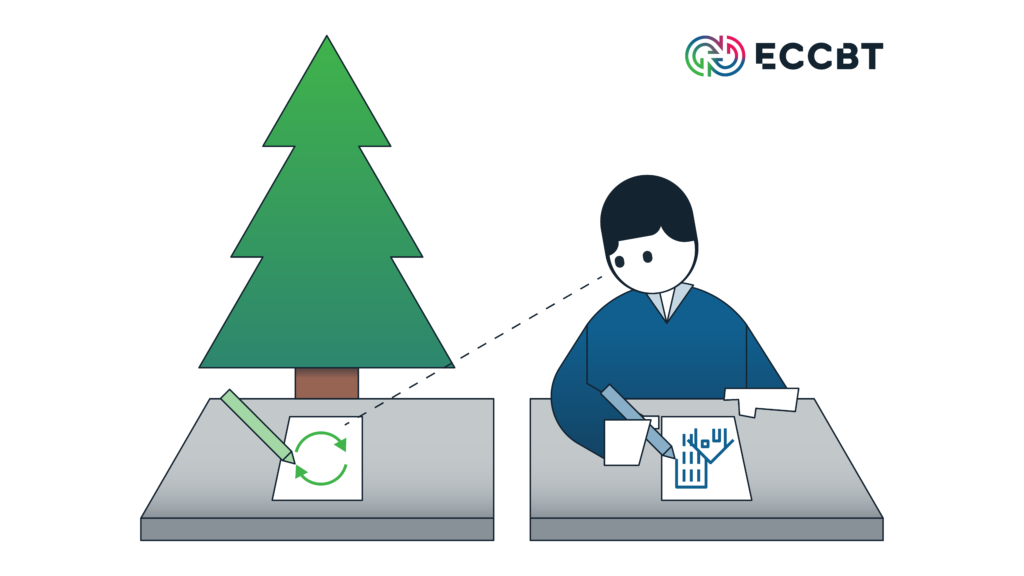
How biomimicry expands circular thinking
Circular economy strategies often focus on reducing waste, reusing materials, and improving recycling. These are important goals, but biomimicry expands the conversation by looking at how living systems create lasting resilience and value.
Five principles are particularly relevant for the built environment.
1. Design for local conditions
Nature never develops a one-size-fits-all solution. A pine tree, a dune grass, and a mangrove each respond differently to their specific environment. They use local opportunities and adapt to local constraints.
For the construction sector, this means paying attention to climate, water availability, prevailing winds, local materials, biodiversity, and cultural context before selecting solutions.
2. Let shape do more of the work
Nature often achieves extraordinary performance through form rather than material intensity. Bones place material only where strength is needed. Trees distribute loads through branching structures. Honeycombs maximize strength while minimizing material use.
The lesson is simple: smarter geometry can often outperform additional material.
3. Use passive processes before active systems
Living organisms frequently rely on natural forces such as sunlight, airflow, humidity, and gravity before expending additional energy.
Buildings can apply the same principle through passive ventilation, daylighting, thermal regulation, and water management strategies.
4. Create multiple benefits
In nature, almost every solution performs several functions simultaneously. A tree provides shade, stores carbon, supports biodiversity, regulates water, and creates habitat.
Likewise, buildings and building products can be designed to deliver multiple benefits rather than solving only a single problem.
5. Contribute to the larger system
Nature does not simply minimize harm. Healthy ecosystems actively improve the environments around them. This challenges us to move beyond the question:
"How can we make buildings less bad?"
toward a more ambitious one:
"How can buildings contribute positively to people, communities, and ecosystems?"
From principle to practice
Biomimicry is sometimes perceived as an abstract design philosophy. In reality, biological inspiration is already influencing products and materials used throughout the construction industry.
The following examples demonstrate how observing nature can lead to practical innovations that improve performance while supporting circular economy objectives.
Bird protection glass
Modern buildings often create a hidden hazard for wildlife. Birds cannot always distinguish reflective glass from open sky or vegetation, leading to millions of fatal collisions each year.
ORNILUX® bird protection glass was inspired by spider webs. Many spider species spin ultraviolet-reflective silk that is visible to birds but nearly invisible to humans. This helps prevent birds from flying into the web and destroying it.
Using a similar principle, the patterns are incorporated such that birds can detect then while remaining unnoticeable for people. The result is a building product that improves biodiversity protection through a design solution rather than relying on additional barriers or operational measures.
Non-directional carpet tiles
Traditional carpet installations often require precise pattern alignment, which can create waste during installation and replacement.
Interface's ENTROPY® carpet tiles were inspired by the seemingly random patterns found on forest floors. In nature, leaves, branches, stones, and mosses create visual coherence without strict repetition. By embracing variation rather than uniformity, these tiles can be installed in multiple orientations while maintaining an attractive appearance.
This approach reduces installation waste, simplifies maintenance, and extends the useful life of flooring systems. It demonstrates an important biomimicry lesson: nature often achieves order through variation rather than standardization.
Wood adhesives without added formaldehyde
Many conventional wood adhesives rely on formaldehyde-based chemistry, which can contribute to indoor air quality concerns and create health risks during manufacturing and use.
PUREBOND® technology takes inspiration from natural adhesion strategies found in living organisms. Nature creates remarkably strong bonds under ambient temperatures and pressures, using chemistries that are fundamentally different from many industrial adhesives. The result is a plywood adhesive technology that eliminates added urea-formaldehyde while maintaining performance requirements for construction applications.
This example highlights a key biomimicry principle: nature often achieves high performance without relying on substances that create long-term ecological or human health challenges.
Five biomimicry questions for every project
Whether you are an architect, contractor, policymaker, manufacturer, or researcher, biomimicry begins with asking different questions.
When starting a new project, consider:
1. How would nature solve this function? Focus on the challenge rather than the current solution.
2. Can shape do the work before adding more material? Look for opportunities where geometry can improve performance.
3. Can passive processes replace active systems? Can sunlight, airflow, gravity, moisture, or natural temperature differences do part of the work?
4. How can local conditions become an advantage? What opportunities exist in the site's climate, resources, ecology, and context?
5. Can this solution provide multiple benefits? Can a product or building element perform several functions simultaneously?
Biomimicry is not about copying nature
A common misconception is that biomimicry means making buildings look like plants, animals, or termite mounds. In reality, biomimicry is less concerned with appearance than with function. The goal is not to copy nature's forms, but to learn from nature's strategies.
Living systems have spent billions of years refining ways to manage materials, regulate temperature, harvest energy, cycle resources, and create resilient communities. By studying these strategies, we gain access to a vast library of tested solutions that can help us build a more circular and regenerative future.
Explore further
Interested in applying biomimicry in your own projects?
Explore the Biomimicry Toolbox to discover methods, frameworks, and tools that help translate biological strategies into practical design solutions.
You can also visit the Vita Pura Biomimicry House to experience how biomimicry principles can be applied within a residential building project and to see nature-inspired design translated into the built environment.