
Most circular business models are built on a clean and compelling promise. Keep products and materials in use for longer, and you will need fewer new resources.
The logic is sound. The reality depends on how people respond to the new incentives these models create.
That is not an argument against circularity. Quite the opposite. As circular business models become increasingly common, the challenge is no longer whether we should adopt them. It is whether we are asking the right questions about how they actually work.
Because the real test of a circular business model is not whether it closes a loop. It is whether it changes consumption.
More than a sustainability strategy
For many organisations, circular business models are becoming less about sustainability and more about resilience.
Retaining control over materials reduces exposure to volatile commodity markets. Designing products for recovery helps prepare for future regulation. Long term service relationships can strengthen customer loyalty and create new revenue streams. Circularity can also help attract talent and position an organisation ahead of market shifts rather than reacting to them.
In short, circular business models are increasingly becoming good business.
At their core, they aim to create, deliver and capture value while keeping products, components and materials in use for as long as possible. Some focus on extending product lifetimes through repair, maintenance and upgrades. Others create systems for reuse and recovery. Some replace ownership altogether, selling performance as a service rather than selling products.
The approaches differ, but they share a common ambition: preserve value instead of continuously replacing it.
What does this look like in the built environment?
Buildings are perhaps the ultimate circular challenge. They are long lived assets made up of thousands of components, each with its own lifespan and future value.
Material passports are a good example. Rather than seeing a building as future demolition waste, a material passport documents what is inside it, making future maintenance, recovery and reuse possible. The passport itself does not reduce material use. What it does is preserve information, and information is often what determines whether materials are reused or lost forever.
Another example is Armstrong's ceiling tile take back programme. Instead of treating old ceiling systems as waste, the company collects them and feeds recovered materials back into new products. Value that would traditionally leave the system through disposal is retained and reused.
What both examples have in common is that they change the relationship between materials and value. They make it easier to recover resources that would otherwise be discarded.
And that is exactly what circular business models are supposed to do.
The question circular business models often avoid
Most discussions about circularity focus on products.
- Can this product be reused?
- Can it be repaired?
- Can its materials be recovered?
These are important questions, but they are not the whole story.
The more difficult question is: what happens once the economics change?
This is where rebound effects enter the picture.
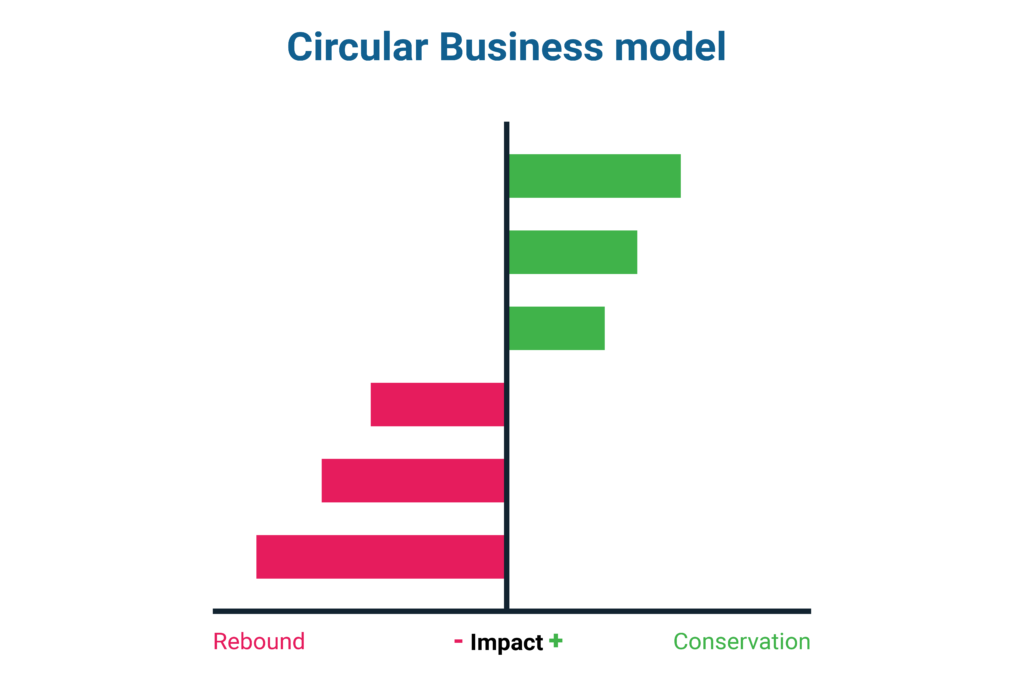
A rebound effect occurs when a circular strategy works as intended, but some of its benefits are reduced by changes in behaviour. The circular intervention succeeds technically, yet the overall reduction in resource use turns out to be smaller than expected.
Consider a product as a service model for interior finishes. The theory is attractive. If manufacturers retain ownership, they benefit from durability, maintenance and recovery rather than replacement. In principle, this should encourage better product design and longer product lifetimes.
There is another possibility however. If replacing finishes becomes easier, more convenient or more affordable, aesthetic upgrades may become more frequent. Products that are still functioning perfectly well may be replaced simply because preferences have changed. The business model remains circular. Materials may even be recovered successfully. Yet replacement cycles accelerate because the barrier to replacement has been lowered.
The products are being conserved. Consumption is not.
This does not mean product as a service is a bad idea. It simply illustrates an important lesson. Technical circularity and actual resource reduction are not always the same thing.
Looking with both eyes open
When evaluating a circular business model, it helps to look beyond the circularity claim itself.
Pay attention to what behaviour the model encourages. Ask whether it reduces the need for new products or simply makes replacement easier. Look carefully at where the business captures value. And imagine what happens if the model becomes widespread rather than remaining a pilot project.
The answers are often more revealing than the circular strategy itself.
Because the future of circularity will not be decided by material science alone. It will also be shaped by incentives, habits and business models.
That should be seen as an opportunity rather than a warning.
Understanding rebound effects does not make circular business models less attractive. It makes us better at designing them. It helps us identify where value is genuinely being preserved and where good intentions might unintentionally create new forms of consumption.
The organisations that will benefit most from circularity are unlikely to be those that close the most loops. They will be the ones that understand which loops actually reduce dependence on new resources and which ones merely make replacement more convenient.
That is not a reason to be sceptical of circular business models. It is a reason to build smarter ones.
Want to create a circular business model and prevent possible rebound effects? Use this tool.