
The transition to a circular built environment is often discussed in terms of materials, technologies and business models. Yet beneath all these ambitions lies a more fundamental challenge: information.
A circular economy depends on our ability to understand what materials we have, where they are located, what they contain and what they are capable of doing after their current use phase. Without that knowledge, products become waste, materials lose value and opportunities for reuse disappear.
This is why the Digital Product Passport (DPP) is becoming increasingly important.
The DPP should not be viewed merely as a new regulatory requirement or another administrative document. At its core, it is an information infrastructure that enables products, materials and buildings to retain their value over time. It preserves knowledge about products throughout their lifecycle and makes that knowledge available to all actors who may need it in the future.
Circular construction starts with material knowledge
The ultimate goal of a circular economy is to keep materials circulating at their highest possible value.
For technical materials such as steel, aluminium and plastics, this means enabling reuse, refurbishment, remanufacturing and high-quality recycling. For biological materials, it means ensuring they can safely return to natural cycles without creating environmental or health risks.
To achieve this, one question becomes fundamental:
What exactly is this product made of?
Without reliable information about material and chemical composition, circularity becomes difficult to achieve. Products cannot be safely reused if their contents are unknown. Materials cannot be effectively separated if their composition is unclear. Potentially hazardous substances cannot be managed if they cannot be identified.
The most important role of a Digital Product Passport is therefore to preserve material knowledge.
A DPP creates a persistent digital record of a product's material composition, origin and characteristics. This information remains accessible long after the product leaves the factory and becomes part of a building.
In many ways, the DPP enables products to retain their identity throughout their lifecycle.
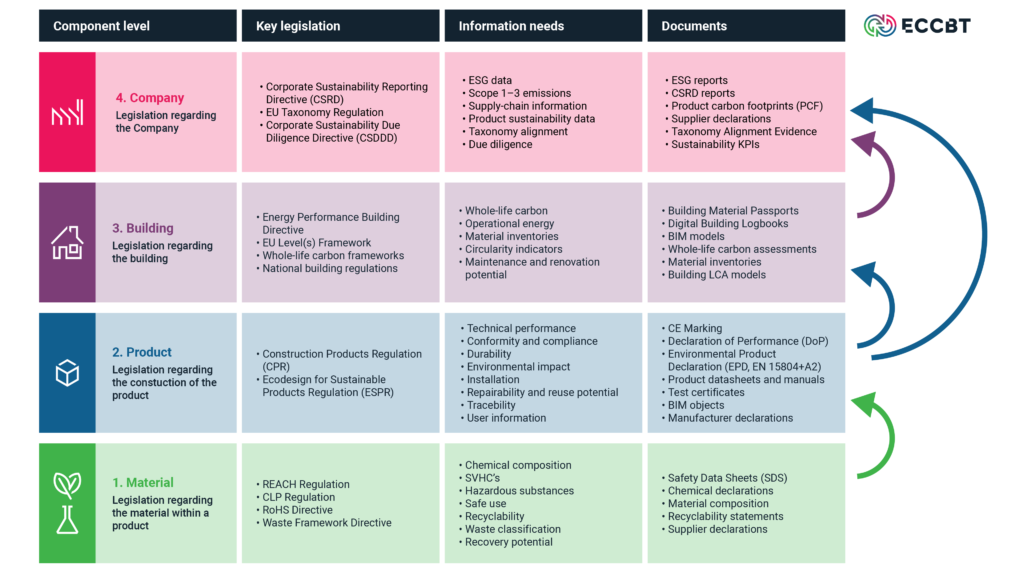
Information creates value
Traditionally, construction products are valued for their physical characteristics: strength, durability, thermal performance or aesthetics.
In a circular economy, information increasingly becomes part of the product's value.
A product accompanied by reliable information is inherently more valuable than an identical product without it.
The reason is simple: information creates options.
When material composition is known, products can be reused more confidently. When performance characteristics are available, products can be repurposed for new applications. When environmental and health information is accessible, risks can be assessed and managed. When ownership of materials is understood, future value can be unlocked.
The DPP therefore does more than support compliance. It increases the future utility of a product by reducing uncertainty.
This is particularly important as buildings increasingly become viewed as material banks rather than end points in a linear economy. The better we understand the products and materials embedded within our building stock, the greater our ability to recover value from them in the future.
From fragmented documents to a single source of truth
The construction sector already generates enormous amounts of information.
Manufacturers create CE markings, Declarations of Performance, Environmental Product Declarations, technical datasheets, safety information and increasingly carbon and circularity assessments.
The problem is not a lack of information.
The problem is fragmentation.
Information is stored in different systems, maintained by different actors and exchanged in different formats. As products move through the value chain, information is often duplicated, lost or recreated. The result is a landscape of disconnected information silos.
The DPP addresses this challenge by acting as a single source of truth.
Rather than replacing existing information products, it connects them through a persistent digital identity. The passport becomes the place where relevant information can be discovered, accessed and exchanged in a machine-readable way.
Machine readability is crucial. Information that can be interpreted by both people and software systems becomes significantly easier to exchange, aggregate and reuse across the lifecycle of products and buildings.
Creating opportunities beyond compliance
The DPP is often discussed in the context of European regulations such as the Ecodesign for Sustainable Products Regulation (ESPR) and the Construction Products Regulation (CPR). While these developments are important, focusing solely on compliance risks overlooking the broader opportunity.
Once a reliable product information infrastructure exists, many additional applications become possible.
Information regarding repairability, durability, recycled content, environmental impacts, emissions, technical performance and chemical safety can all be linked to the same product identity. This allows organizations to use the same information for multiple purposes rather than collecting it repeatedly for different reporting obligations.
More importantly, it allows organizations to better understand the products and materials they own.
This knowledge supports better procurement decisions, more effective asset management, improved circular strategies and better identification of future opportunities.
It also helps organizations identify potential risks and exposures. If material composition is known, hazardous substances can be identified more easily. If environmental performance is documented, improvement opportunities become visible. If products are traceable, alternative materials and substitutions can be evaluated more effectively.
In this sense, the DPP is not simply a compliance tool. It is a decision-support tool.
From products to buildings
Products never exist in isolation. They ultimately become part of buildings and infrastructure.
This is why Digital Product Passports should be viewed as part of a broader digital ecosystem that includes Building Material Passports and Digital Building Logbooks. Together, these systems create a digital chain of information that extends from materials and products to entire buildings and portfolios.
This enables building owners, municipalities, housing corporations and other stakeholders to gain a better understanding of the resources embedded within their assets and to make more informed decisions about maintenance, renovation, reuse and redevelopment.
Building the foundation for circularity
The circular economy cannot function without reliable information.
Materials only retain their value if their properties remain known. Products can only be reused if their characteristics remain accessible. Buildings can only become material banks if the resources within them can be identified and managed.
The Digital Product Passport provides the foundation for this information infrastructure.
By preserving material knowledge, reducing uncertainty and connecting fragmented information sources, the DPP enables products to remain valuable long after their first use phase has ended.
Compliance with future regulations may be one benefit of this approach. But the greater opportunity lies elsewhere: understanding what we own, unlocking the value of existing material stocks and creating the conditions for a truly circular built environment.
If Digital Product Passports are the infrastructure for a circular economy, then the question becomes: what information should actually be stored within them? This paper introduces the Product Circularity Data Sheet (PCDS), a globally oriented framework that helps standardize circularity information at product level and lays the foundation for better reuse, recovery and value preservation.
Want to get more hands-on? You can also check out TerraMatters and freely fill in the PCDS yourself for your own product.