
Over the past decade, biobased materials such as timber, hemp, straw, cellulose and mycelium, have regained attention as alternatives for more sustainable construction. These renewable materials are increasingly promoted as solutions to store biogenic carbon and reduce dependence on finite virgin resources.
This is a welcome shift. However, a growing challenge is the tendency to equate biobased with circular. While renewable origin is an important characteristic, it tells us little about what happens to a material after decades of use in a building. The more relevant consideration is whether the material can successfully and safely retain value through one or more material cycles.
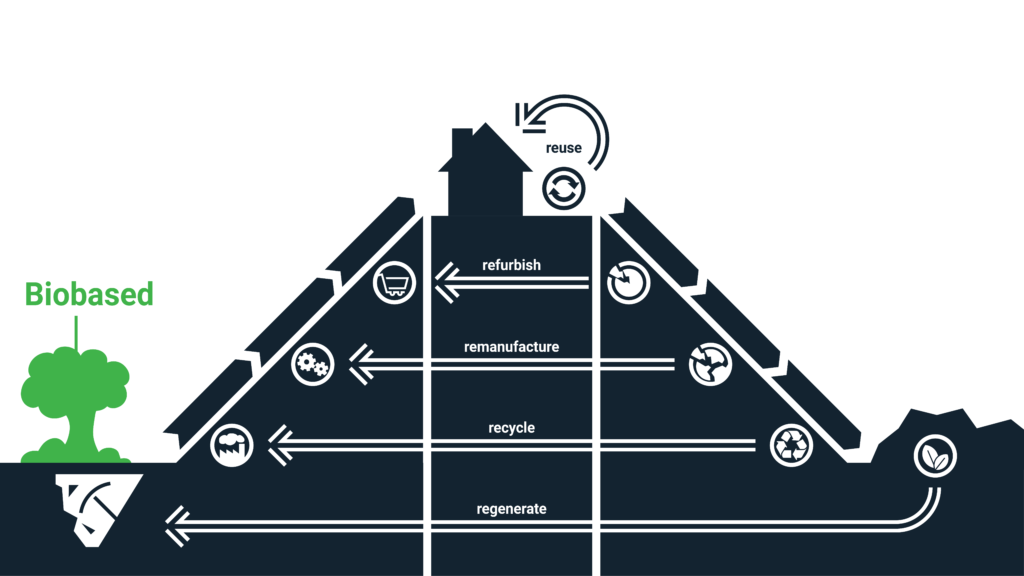
To assess whether a biobased material is genuinely suited for circular use, consider the following questions.
How was the material sourced?
Feedstocks sourced from regenerative forestry or agriculture may provide additional benefits related to biodiversity, soil health and ecosystem resilience, when compared with more intensive production systems. Material sourcing can therefore influence not only resource use, but also the broader environmental impacts associated with a product.
Which circular pathway is the material designed for?
Most biobased construction materials can follow multiple pathways during their lifetime. The key question is whether the product has been designed to retain as much value as possible throughout successive material cycles. For durable building applications, timber products with load-bearing capacity are often best used in ways that allow maintenance, repair, reuse and refurbishment before any further processing is considered.
Product design should therefore start by identifying realistic future pathways for the material. These may include direct reuse, remanufacturing, material recycling, or eventually biological recovery. The suitability of each pathway depends not only on the base material, but also on how the product is assembled and what additives, coatings or binders are used.
Some biobased products, such as OSB panels, illustrate this challenge. The use of synthetic adhesives can restrict future recovery options by limiting biological recovery while simultaneously reducing opportunities for high-value reuse, separation or material recycling. Assessing circularity therefore requires looking beyond renewable content and considering the quality and feasibility of the pathways available at end-of-life. You can do this by looking at the following sub-questions (a and b for technical cycles, c and d for biological cycles):
a. Can components be separated?
One of the most overlooked aspects of circularity is separability. Many building products combine materials with different recovery pathways into inseparable composites. While such products may perform well during use, they often become difficult to recover at end-of-life. A solid untreated timber beam can be reused, repaired or ultimately biodegraded. A composite panel containing wood fibres, synthetic resins and multiple coatings presents far fewer recovery options. The easier it is to separate components, the greater the number of future circular pathways.
b. How much value can be retained?
To preserve the value of biobased materials, products should be designed so that these materials can pass through multiple high-value applications before eventual recycling or biological recovery. A timber beam which is reused for another fifty years generally represents a more valuable circular strategy than one that is shredded or composted. Materials should therefore be assessed on their ability to maintain functionality and value through multiple life cycles.
c. Is it actually biodegradable?
Biobased does not necessarily mean biodegradable. Many products contain synthetic binders or are chemically modified in ways that significantly reduce their ability to biodegrade or prevent it altogether. Others may only degrade under industrial composting conditions that are rarely available in practice. Biodegradability should therefore be evaluated under realistic end-of-life conditions.
d. Can the material safely function as a biological nutrient?
A biobased material can only be a biological nutrient if it can do so safely for both humans and the environment. This requires looking beyond the primary material, by examining additives, coatings, preservatives, flame retardants, binders and treatments. If degradation releases harmful substances into soil, water or ecosystems, biological recovery becomes undesirable regardless of the material’s renewable origin or degradability.
Can the intended pathway be realized in practice?
Perhaps the most important question is whether a realistic recovery pathway exists at all. Many materials perform well in theoretical circularity assessments but lack practical collection systems, recovery infrastructure or established markets for secondary use.
A biobased material that can cycle multiple lives in theory but is rarely reused in practice may be less circular than a simpler alternative with a well-established recovery route. For public authorities in particular, procurement criteria should increasingly focus on demonstrated recovery pathways rather than merely material composition. This can be explored by requesting evidence of the mechanisms that enable recovery in practice, such as:
- Design-for-disassembly criteria
- Digital product passports
- Evidence of take-back schemes
- End-of-life recovery plans
- Functioning reuse markets
From material origin to material destiny
The transition to biobased construction remains important for reducing environmental impact and supporting a regenerative economy. Yet focusing exclusively on renewable content risks overlooking what ultimately determines circularity: what happens after use. A circular material is not simply one that comes from nature. It is a material that has a clear, safe and valuable pathway into its next life.
For construction professionals and policymakers, this means shifting attention from material origin to material destiny. The most successful biobased materials will not be those with the highest renewable content, but those that can retain value through multiple cycles while avoiding harmful impacts on people and ecosystems.
That is the difference between a material that is just biobased and a material that has a future.