
The transition toward a circular economy is often associated with recycling, remanufacturing, and the use of secondary materials. In the construction sector, this includes approaches such as material passports, modular design, and the closing of material loops.
Circularity also raises a fundamental question:
Do we want materials to circulate indefinitely if they contain hazardous substances?
In a circular economy, material health become a crucial factor to determine reuse potential. Materials remain in circulation for longer periods, are processed multiple times, and may eventually end up in different applications than originally intended.
For this reason, material health is gaining importance in circular construction.
From Risk Management to Prevention at the Source
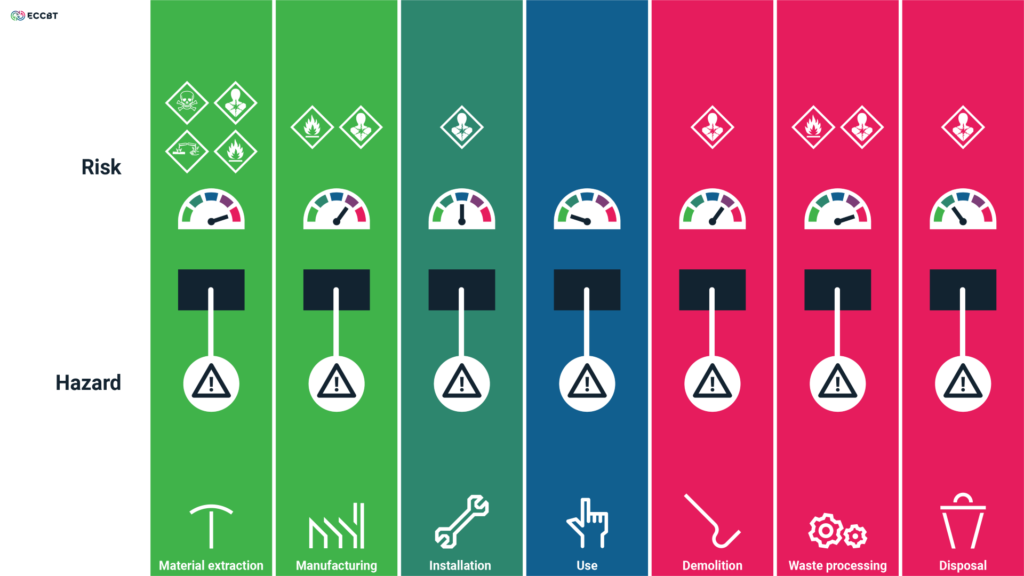
A clear distinction must be made between hazard and risk.
A substance may have hazardous properties. For example, it may be:
- Carcinogenic
- Hormone disrupting
- Persistent in the environment
- Toxic to ecosystems
Whether harm actually occurs depends on exposure-related factors such as:
- Level of exposure
- Duration of contact
- Method of use
- Environmental conditions
Gasoline is a simple example. It is hazardous due to its flammability and toxicity, while the risk depends on how it is stored and handled.
In a linear economy, as shown in the image below, management typically focuses on controlling risks through safe use and end-of-life disposal. Materials are usually assessed within a single application and a defined lifecycle.
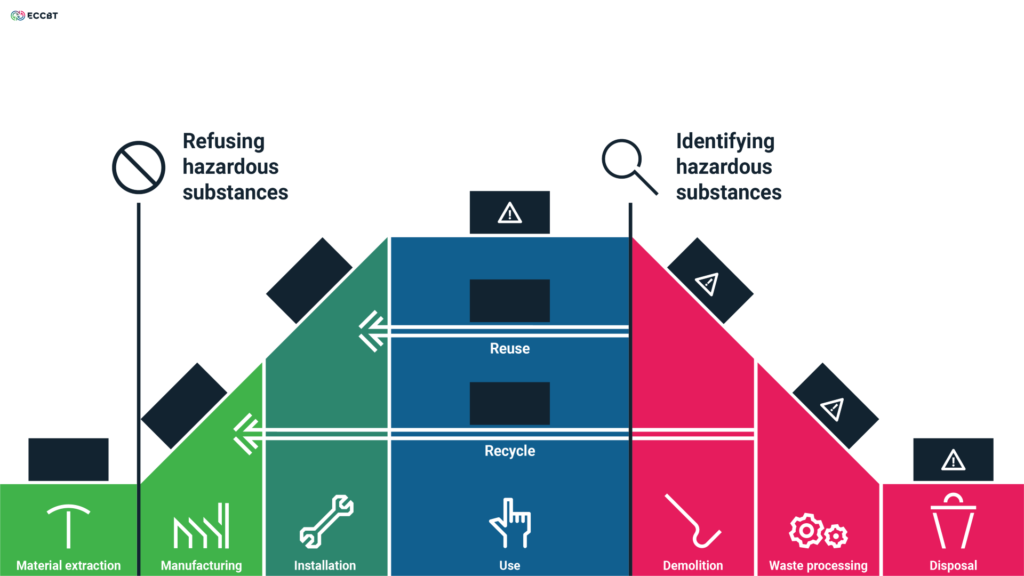
A circular economy changes this perspective. Materials no longer follow a single lifecycle. Buildings become material banks, and products are dismantled, reused, and recycled. As a result, substances may remain in circulation for decades or longer, with previously unforeseen uses.
This leads to a key question: what happens if a substance continues circulating through future material cycles?
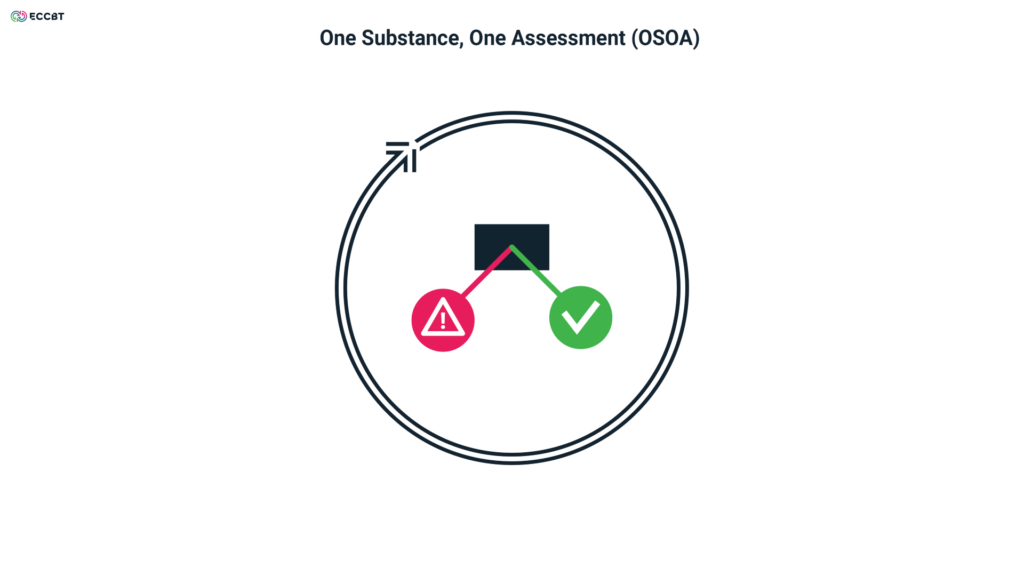
A material that is acceptable in one application may present challenges later. Circularity therefore requires not only risk management, but also the prevention of hazardous substances entering material cycles. The European Commission works on this using the idea of “One Substance, One Assessment”.
Tomorrow’s Problem Starts Today
Construction materials often remain in use for 30, 50, or more than 100 years. Substances considered acceptable today may therefore become future environmental or health concerns. These are often referred to as legacy pollutants: substances that persist in buildings, products, and recycling streams long after their original use.
Examples from the past include:
- Asbestos
- PCBs
- Lead-based paints
Current discussions include:
- PFAS
- Certain flame retardants
- Plasticizers
- Biocides
Flame retardants in insulation materials illustrate this issue. While originally introduced to improve fire safety, different concerns are raised in other stages of the lifecycle. A product may be safe for occupants while still posing risks for workers handling, cutting, or processing it. Circular construction therefore requires a full lifecycle perspective on material health.
Why Existing Regulations Are Not Sufficient
In the EU, REACH is the main regulatory framework for chemical substances. It covers:
- Registration of chemicals
- Hazard identification
- Risk assessment
- Authorization
- Restrictions on substances of very high concern (SVHCs)
REACH is an important instrument for improving transparency and protecting health and the environment. However, it was primarily developed within a linear economic model, where substances are assessed for specific applications under defined conditions of use.
This does not automatically ensure suitability for repeated circulation across multiple life cycles. A substance may be legally permitted given its current use, while still being unsuitable for circular use.
For this reason, additional frameworks such as Cradle to Cradle Material Health (C2C) take a broader approach. They consider not only hazards in current use, but also potential behavior across future cycles and exposure scenarios.
The focus shifts from managing risk to:
- Designing healthier material streams
- Enabling safer circular systems
- Supporting more robust design decisions from the outset
For more information on restricted and authorized chemicals, refer to this public database from the European Chemicals Agency (ECHA).
Transparency as a Condition for Circular Construction
A circular economy depends on transparency regarding material composition, including contained substances and associated risks.
This increases the relevance of tools such as:
- Material Passports
- Material Safety Data Sheets
- Environmental Product Declarations (EPDs)
- Health Product Declarations (HPs)
- Digital Product Passports (DPPs)
Without transparency, hazardous substances may unintentionally circulate in new applications. Authorities such as the Dutch Health Council have also highlighted the risk of unwanted reintroduction of hazardous substances through recycling streams.
In circular construction, information is therefore a key prerequisite for system control.
For more information on Digital Product Passports, check out this article.
Managing Existing Material Streams
The challenge is not limited to future materials. The existing built environment already contains large quantities of materials with potentially hazardous substances. These will remain part of material flows for decades.
Circular strategies must therefore also address:
- Identification of hazardous susbtances in existing buildings
- Assessment of safe reuse potential
- Prevention of contamination in recycling streams
This creates a trade-off. Recycling can reduce environmental impact and resource use, but it may also spread hazardous substances into new applications.
View this report from the MOBBICON-PRO project to see how to perform a pre-demolition audit and identify hazardous substances.
Towards Safe and Circular Material Flows
The transition to a circular economy requires a broader perspective on materials. Not only whether something is recyclable, reusable or low-carbon, but also safe, transparent and healthy.
Without attention to material health, circularity may unintentionally lead to long-term circular of hazardous substances. For circular construction to be effective, materials must be both reusable and compatible with long-term human and environmental health.